Disclaimer

The content of this blog reflects my personal experiences and opinions during my veterinary school education. It does not reflect the experiences or opinions of my classmates, colleagues, or the UC Davis School of Veterinary medicine. If you wish to contact me via email: hamaleo11@gmail.com

Sunday, October 7, 2012

A Summer of Travel Part 2

I know it's been a while since I've been able to post about the rest of my summer travel experience, but here it is! Of course right before a hell week of 4 exams!

I'm planning on making a special post about the rest of my time at the American Fondouk. My experience volunteering there was not the best and there are many factors that contributed to my specific experience there that require a post in itself to explain. I am happy the American Fondouk exists as a resource for Moroccans and their equids and I admire those struggling to run a clinic in the political and progressive Morocco. I'm accounting my diminished experience mostly to bad timing. The UK veterinarian I looked forward to meeting so much was on holiday during my time at the American Fondouk and in her absence I believe the clinic didn't run as smoothly as it should have.

I spent two weeks at the American Fondouk volunteering. After that I spent a week traveling Morocco. I stayed two nights in the city of Fez where I got to explore the city with one of my fellow externs who was from the US originally, but more recently the UK. We traveled 4 hours north by bus to a small mountain town called "Chefchaouen" that was very peaceful and relaxing. We climbed the mountain towering over the town. It's an amazing city and known for it's rich blue colors. Here is a utube video because it's beauty was just so hard to capture in a still shot:  http://www.youtube.com/watch?v=T4kY0gH9PpA
 
Overlooking Chefchaouen
Chefchaouen
During my time in Morocco I also saw one of the largest stables - "The Royal Stables in Meknes are an amazing site, as this massive stable yard was constructed to comfortably house no less that twelve thousand of the royal horses. Ismail had a great respect and admiration for these gracious animals, even more than he did for his human counterparts. His horses were waited on hand and foot, with a groom and a slave for each horse, to ensure that all their needs were met, stables kept in immaculate condition and his horses being taken care of. It is even said that after a horse had completed a journey to Mecca, slaves were forced to catch the urine in a bowl, as even the earth was too undeserving for the horse to urinate on. It is easy to say that Moulay Ismail was fanatical about his horses...Another feature that makes the Royal Stables in Meknes one of the finest tourist attractions in Morocco is the planning and location that was specifically chosen to accommodate the horses. There is a canal that ran fresh water through the stables constantly, so the horses never lacked clean water. Also, the sultan was concerned about the feed supply for his stables, and constructed a granary, known as the Water Palace (Der el Ma), behind the royal stables. The granaries were built on a reservoir and were designed to be able to store grain for the horse feed. To feed twelve thousand horses is already a great feat, but the granaries stored enough grain to feed the horses for twenty years!" 
Read more: Morocco.com Channel http://www.morocco.com/blog/royal-stables-in-meknes

The Royal Stables

I visited a Medersa or school of religion. I stayed in a Riad for one night - which was truly a guilty pleasure! I even got to go in a Mosque! I also saw the Roman ruins of Volubilis in Meknes/Idriss. 

To see my photos: (caution some may be of wounds in animals) 
https://picasaweb.google.com/hamaleo11/TheAmericanFondouk?authuser=0&feat=directlink

I think the biggest impact Morocco had on me was the feeling of a country being stuck between modernization and it's cultural roots. The Muslim religion and culture are a big part of Moroccan life and played a pivotal role in keeping Morocco feeling "old". Morocco is a developing country, but it is very different from Peru or Bolivia (from my personal experience). I haven't quite put my finger on it. 

The tension between traditions and modernization will continue to be an ongoing issue in Morocco. A big part of this battle affects the working animals of Morocco. As the new generation seeks to embrace modernization they have little desire to learn the old ways of how to care for animals and use them efficiently for work. As poverty and political issues seem to be a continuing problem for many in Morocco, they are forced to continue use of working animals although they have no desire to. I honestly believe they are thinking about their near future when they will no longer need that animal, it will be replaced by a motor. The younger generation doesn't think about using an animal for work so it will last longer, but using that animal for work now in a purpose that animal will not be needed for later. Life is tough for working equids in Morocco!

Donkeys hauling trash from the Fez medina 
The "modern" Moroccan mule!

To be continued...in a "Summer of Travel Part 3" - My trip to Poland & Italy!


Friday, September 21, 2012

Veterinarians are OVERPAID? I think not...

I recently read an article on Salary.com titled, "The 8 most overpaid & underpaid jobs". The article compares several profession's salaries and how they are either overpaid or underpaid. The author, Dawn Dugan, even states: 

"In this article I’ll compare eight overpaid jobs with eight underpaid jobs. My methodology? None. I realize that some jobs require a certain level of training and education, while others are merely the victims of supply and demand. While I feel that all the jobs on this list have merit, they simply represent -- in my humble opinion -- jobs that are paid more or less than they are worth given day-to-day responsibilities and duties."

Let me just start by saying I did not seek out this article, but saw it posted on Facebook by a friend. The statements this woman makes are extremely inaccurate. I want to focus mainly on her comparison of Pest Controllers and "Research" Veterinarians. You can see the article by clicking on the hyperlink:
  
http://www.salary.com/the-8-most-overpaid-underpaid-jobs/slide/2/

I don't know how articles like this are written in the first place, especially with no foundational facts or previous field experience. This woman has absolutely no idea what it is like to be a research veterinarian, so what gives her the right to voice her opinion on something she has absolutely no knowledge about? She also has no idea what a veterinarian does all day from her statement: 

"...Veterinarians, for the most part, work in clean, well-lit environments with domesticated animals. While they may be on call for emergencies, their hours are relatively predictable and the pay is above average as well."

I'm sorry Mrs. Dugan, but first of all, veterinarians differ from "Research Veterinarians". They have go through a lot more education than your average veterinarian. 

Research veterinarians are not overpaid...nor are your average veterinarians! Your article is very fallacious. A lot of research veterinarians work with food animals and other large animals like horses, you tell me if that is a "clean, well-lit work environment with predictable hours" - I think NOT. Having been part of a research team myself. A lot of the studies we do are for people using an animal model. That's pretty valuable don't you think? Not to mention that "Veterinary Researchers" go to school for 4 years of undergraduate, four years of veterinary school AND four years of a Doctorate program - some even complete Residencies! Can you add up all those loans? That's a pretty measly salary for 12+ years of your LIFE!

Mrs. Dugan has a B.A. in English/Writing from St. Lawrence University. You'd think she would research the facts before writing and judging any profession or providing her very own "professional" opinion. Salary.com should be ashamed of this article and it's fallacious statements.

Friday, September 14, 2012

Starting My Third Year of Veterinary School

Photo Credit
It's that time of year again, long before the rest of UC Davis begins, the last of the old veterinary school curriculum begins their daily pilgrimages to school. (Although the 1st and 2nd year students started weeks before us cause they are on the semester system). 

This time instead of having lecture in the new and fancy Gladys Valley Hall, we have the majority of our lectures in Schalm 170, the dark and uncomfortable classroom from the early 80's? Yeah, you could say we were spoiled as first and second years, but we're at the peak of our curriculum, less than a year away from beginning our clinical year in the VMTH. We're the last of the old curriculum and yes, we are thankful for our electives!

I'm halfway through veterinary school and man, how time has passed me by! I've done a lot in my short while here, and it's all been worthwhile. 

This quarter, I'm taking both equine and small animal medicine courses and a mirage of electives, such as equine reproduction, large animal toxicology, & small animal radiology case discussions. Our core classes include ophthalmology, neurology, orthopedics, doctoring and surgery! 

Yes, we are starting our surgery courses! That means we get to perform our first surgeries this quarter! This is both exciting and scary. I'm lucky to have such amazing faculty to help me through the process and did I mention the best surgery team? 

Third year is off, my first exam is this weekend, and then one next week (wow...exams in the third week of school! That's a nice change! ;). Haven't even tried to make an exam count for the entire quarter yet, but I know there are a few in each class. 

Wednesday, September 5, 2012

Volunteering for RVETS - Life Lessons

The Veterinary Team
What an amazing end to my summer! A trip to Northern California with RVETS (Rural Veterinary Experience & Training Services). I learned so much from Dr. Davis and Cindy! They are such humble and patient people and amazing teachers with a passion and a talent for the work they do. I really enjoyed the opportunity to work with them and learned so much and got to do so much to help animals in need.
"Gelding Clinic"

On Friday, August 24th, we left the Davis campus following the RVETS bus headed for SAFER equine rescue in Sonoma, CA to castrate a horse. 

Then we traveled to Covelo, CA (which for those who don't know is roughly north of Willets about an hour near Round Valley. We set up our small animal equipment that night and made sure everything was prepared for the next 2 day small animal clinic. Most of our procedures were spays and neuters while we also did two Etropians, a facial mass removal and a retrieved a fox tail from a dog's ear! 

That Monday morning we traveled to Kettenpom to do a horse clinic (plus a cat spay and a dog neuter). We did some equine dentals, castrations, and a hernia surgery. After a lot of driving on a dirt/gravel road we arrived to a paved road that took us to Red Bluff, CA where we had another gelding clinic. By this time, we were getting good at setting everything up and knocking out those castrations! After a half day, we headed back to Davis which would be our home base for the next couple of clinic days.

I'm castrating a MINI MULE !
Monitoring Anesthesia on a mini horse
Our first two days we worked out in North Highlands area and castrated roughly 32 horses and did a couple of hernia repairs over those 2 days! On our last day, we worked out of a barn in El Dorado, CA...that's right, my home town! It was so neat to be able to do veterinary work in my hometown for rescue groups that needed the services RVETS provides. Of course I ran into someone I knew! Reflecting on my week volunteering with RVETS, I wouldn't change anything about the experience, it was truly amazing! It was hard work and a lot of missed sleep, but I love working hard, and have a passion for learning!   


Thursday, August 23, 2012

A Summer of Travel Part 1

~~~~~~~~~~~~~~~~~~~~~~~~~~~~~~~~~~~~~~~~~~~~~~~~~~~~~~~~~~~~~~~~~~~~~~~~~~
This summer I traveled to Europe/Africa for almost two months. I began my adventure in London where I explored all the tourist attractions and felt the buzz from the soon to begin Olympic opening ceremonies. The following are excerpts from my mass email to friends and family. I will have several parts to share about my travels, as I had some very unique experiences while abroad.

"I've made it to London, which is by far more amazing than I really expected. I've been here since yesterday afternoon and my feet are tired! My hostel is great for the price, however it is far from central London (and the touristy spots). I have become very familiar with riding the London underground which is much like the RT in Folsom or the Bart in SF, but it is much more efficient. You can get a day pass for £8. I never wait more than 2 minutes for a train and it is so easy to use! I think they are preparing for the Olympics because there are maps and signs everywhere as well as real people to help you with tickets or your travels.

I've seen a lot of the tourist traps and a few of the hidden treasures. I spent yesterday seeing the
London Eye & the London Bridge, then I roamed through Camden Town, which used to be an old stable yard for the horses that pulled the barge. It is now a market place for tourists as well as London locals. There were many cool horse statues and alleyways leading to endless shops! There was also cheap food of any nationality you could want, even Mexican food, although I was a bit suspicious! I then headed to Primrose Hill which is a park above the park where the London Zoo is that overlooks the entire city! It was so beautiful and the weather was amazing (still is amazing) so I have plenty of pictures.

Today I went to Green Park around 9AM and strolled around there and stumbled upon Buckingham Palace, I knew it was there, but it was so majestic and huge I didn't expect it! I walked up to the gates (there was hardly and tourists at that time) and I saw the guards standing there like stones. I discovered that you can tour the Royal Mews or 'Stables'. That was really cool and totally worth the £7!! I saw the Queens carriages and two of her carriage horses. Many of the horses were not there because they were at an event, but they say it is the oldest functioning stables. I really enjoyed that! I left there around 11AM just in time to stumble across the changing of the guard in front of Buckingham Palace. That was lucky! They also have many black horses that joint the parade, marching band, and soldiers and all, such a big production! Then I headed to Westminster Abby and saw all the sites there, I decided to skip going in the big cathedral because of the line and I just took photos and walked around. The buildings are so old and lovely! Then I went to the
London Tower and saw the Queens Jewels! That was a really fun place to walk around in and see all the history there. It was very crowded!"  


Then I traveled by Eurostar to Paris, France just two days after arriving in London. 

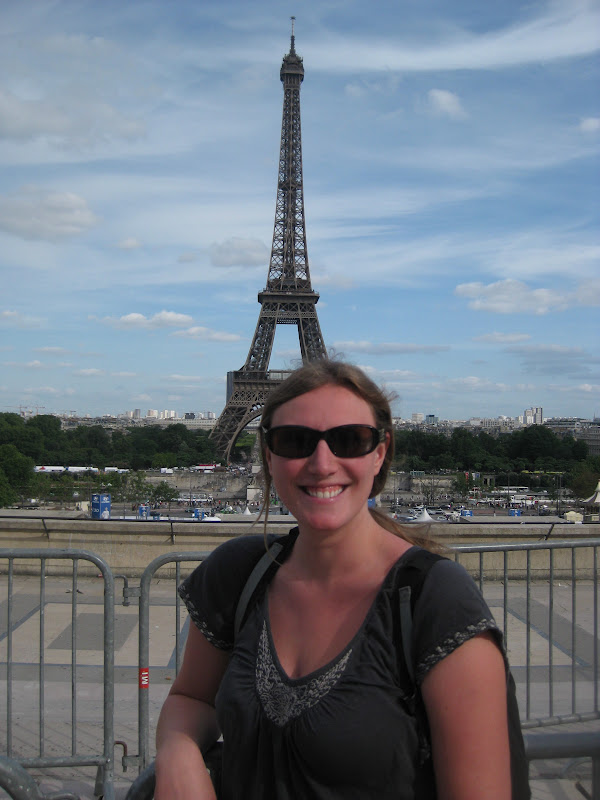
"I had an amazing time in Paris, a city with vibrant history, culture and nightlife. I stayed near the Montremart district which is near a really gorgeous cathedral called"sacred heart". The hostel was nice, I stayed in a 4 bed female dorm with an Argentinian and a Canadian (Montreal). The Canadian and I went on a free 3 hour city walking tour and saw all the main sites and got quite a bit of a French and Paris history lesson. We spent the rest of the day at the Eiffel tower where we took a Cruz at sunset in the Sin or Sen which is the water that runs through the city. On our way back, we saw the Eiffle tower sparkle on the hour at night. So beautiful! I have some great pictures. The next day, we relaxed a bit and strolled through The Eiffel tower park area with one of the Canadian's friends. After we got more pictures, we had drinks at a non-touristy bar. The metro station is really crazy in Paris! I finally got the hang of it! I really enjoyed Paris, but I feel like I saw enough of it in just a couple days. I was so lucky to have such good weather! I took the Eurostar between Paris and London. It was such a smooth and pleasant ride!"

After two nights in Paris I headed back to London...to fly to Fez

"I basically traveled all day on Sunday. Train from Paris to London, then I flew to Fez. The airport was an hour outside of London and I took a bus there. On the way, I got to see the structures for the Olympic games they are still building and lots of farms/small communities filled with green pastures. So wonderful!

Then I landed in Fez, Morocco, it was 102 degrees. A driver for the Fondouk was waiting for me at the airport with a sign that had my name on it, which was comforting. On our drive to the Fondouk, the streets and town we passed reminded me a lot of Mexico. The houses were half built, many abandoned, people were walking along the street, almost all, but not all women are covered here. Some are wearing more modern clothes, although all their shoulders are covered, many people, including women wear sandles, contrary to what I read, it is NOT rude to show your feet in public. We arrived at the Fondouk around 8pm and I was introduced to the other volunteers: the first left the same night, but I got to talk to her a lot about her experiences, she was a student at Tuffs in MA. There us a Canadian vet student, Then my roommate, Camelia is from Poland and is a recent veterinary graduate. Then there is an intern here who studied in Morocco, then there is a couple who are vet students from the Czech Republic. The final person arrived today and is a recent graduate from the university of Edinburgh. The main doctor and assistant director of the Fondouk is also from Morocco, but he speaks very good English! He also knows French, Arabic, And Berber. Unfortunately, Dr. Gigi Kay who is the director is away on holiday the whole time I am here. I'm kind of bummed about that because she is more into teaching than the Moroccan vet. I wanted to meet her since she has a long history of working in third world countries providing veterinary aid.


The Fondouk has about 16 patients right now all undergoing treatments, one mare had a swollen hock and a referring veterinarian "cut" it open to drain it, but opened the joint capsule which is really bad. She does not bear weight on the hind leg where her hock is very swollen. Today they flushed it. Her progress is limited and humane euthanasia is on the table, because she has a very bad condition and will likely not be able to return to work. According to the externs who have already been here 2 weeks, we have seen 2 rabies cases in donkeys and several others with Tetanus. One donkey survived Tetanus but then got thrombolitis of her jugular vein, tomorrow we are doing surgery to fix that.


It is very different here at the Fondouk, both in the way animals are presented and in the way they are treated. Costs are cut if at all possible, we make our own fluids. I've learned to make some interesting bandages already. It's heartbreaking to see some of these animals, by the way the Fondouk only sees horses, donkeys and mules.


My first day and a typical day at the Fondouk: wake up at 6:45, eat, do TPRs, the staff does the morning treatments (giving medicines/hot compresses/etc. Then the gates open from 8am to noon and we accept patients. At noon we shut the gates and make our new patients comfortable. Then we take an hour lunch ( I got in the pool) and then we head back to work at 2pm, we do all our procedures and surgeries. Then we finish whenever we finish, which today was about 5:30. Then we went back in the pool! At 7:30 we do our evening treatments. Today I helped clean up the extern house!


A successful first day! Tomorrow after our day is done, Kamila and I will head into the city. I will tell you about the Fondouk's animal residents in the next email. The Fondouk is truly an oasis in Fez, I am very lucky to be here! It's sad that the horses/donkeys/mules do not get fly spray or fly masks and there is a huge fly problem here! I have some ideas to improve the quality of their lives. Luckily I am making a dent right now, but there is just so much more to it.


Also it's neat to hear the call to prayer four times per day. It's actually quite relaxing and peaceful."


"Today is my second day at the American Fondouk. I've seen some amazing and very sad things in my short time here. The lives of the working animals in Fez, Morocco are very different from those back at home who are pets or top condition competition animals. I do realize we have poor treatment of animals in the US too, but far different from the Moroccan workhorse or mule.

I've settled into my room at the Stuart Villa which is really an oasis here at the Fondouk, I will be trying to send some pictures of my travels shortly if time and the Internet connection permit. The other externs and I have become quite good friends, especially Kamila and I (the Polish veterinary grad). She wants me to skip Italy and come with her so she can show me Poland, but I will save it for another trip. It has always been my dream to visit Polish Arabian Horse breeding farms there.


Anyways, back to the Fondouk.. the way it works here in the Villa is some of us go to the grocery store every 2/3 days and purchase food, someone cooks dinner for everyone at tonight and the food is comunal if it is in the fridge. You have to keep it in your room if it's personal. Everyone is great with sharing and the cooking and dishes. We have a women who cleans the kitchen, shower and toilets everyday of the work week. Lunch here is provided,  a sandwich.. Of cut up hard boiled egg, tomato slice, lettuce(sometimes) and light mayo. I've been told they can get very boring. On Fridays, we get couscous, which I can't wait for!


We buy tons of bottled water here, and I drink a lot during the day, today it was 108 degrees, which was hot, but much like home on a hot summer day. Usually the water is room temperature, although I often fill and stick my water bottle in the fridge. The fridge is cold, but not super cold. There is a water dispenser in the treatment area that gives coldish water, but I will really enjoy a water with ice when I get home! We have to wear coveralls in the mornings when the Fondouk is open to the public. They are nice quality, but still very warm. I take mine off and wear scrubs as soon as I can.


In the villa yard, we have tortoises, almost 10 I'm told, you can catch them hiding under the plants in the dirt where it's cool, I fed one watermelon yesterday. We have about 5 cats running around the Fondouk, they look well fed, and love being petted and scratched. They have a hard time with the heat cause of so much fur and they lay in the shade up against the buildings, in the middle of the day they sleep in these cool places. There is a miniature donkey that came into the Fondouk with a rectal prolapse about 3 months ago, the prolapse is chronic and we have to periodically push the small part of it that sometimes bulges out back in. His owner never came back for him. He doesn't have a name, but I call him monkey, he's got a lot of fur and is a curious little guy that runs loose around the Fondouk (except when the main gates are open). He's always trying to stick his nose in your business and is always stirring up trouble, he knocked down a decorative vase yesterday tearing around the villa.  He's got a lot of spirit and love to share. You can often find him hiding in our small pharmacy shed which is air conditioned or hanging out by the pool watching us swim, he's quite a spoiled donkey. We also gave 4 dogs, 2 younger and 2 older. They are sweet and loving too.


Today I changed many bandages, some wounds look better, others are not improving. I've gotten some pictures of before and hopefully will get afters. There is one grey mule mare that had a swelling in her hock on her leg and the referring vet cut it open to drain, but he cut the joint capsule open too and the joint is now badly infected. She is on pain medicine and antibiotics and we flush the joint everyday. Surgery here is far from sterile, we scrub once, then rinse with our homemade distilled fluids. they use sterile instruments and gloves, but with the amount of flies here it is literally impossible to keep things sterile. The mare has a very poor prognosis and we are waiting for the owner to return so we can discuss ending her suffering.


Today someone dropped a kitten in front of the Fondouk, it was crying at the door and Kamila and Alicia took it in. It was crying it's head off, probably about 3 months old. She was white with bright green eyes. Unfortunately, there is not a place for all animals at the Fondouk and this happens way too often, but the Fondouk staff euthanized the kitten. It was saddening for me and the other volunteers, but we understand the financial limitations and implications if that animal survived. She was given love and a good meal before her short life ended peacefully, life for a cat on the streets in Morocco would be tough. Sorry for the sad story, but there is a lot of sad here for the animals.

We had a female donkey come in today and we removed a huge urolith from her urethra, it was huge! The removal looked painful, although she was sedated.


We also removed some leftover testicular tissue from a donkey that was improperly castrated with a knife. This is a common issue in Morocco even though the American Fondouk offers free castration services. This involved anesthesia and the donkey was laid on a large pad on the ground, I was helping monitor his vital signs and anesthetic depth, at one point he was very light and I could tell he was feeling it. His front legs were moving, I asked if I could give him more drugs (which I had on hand already drawn up) and the Moroccan doctor looked at me and said coldly, many vets in morocco don't even use sedation. I was kind of taken aback cause I'm sure he would want some good anesthesia if his testicular tissue was being removed! :(

Medicine here is much different from at home, but the animals are different too. They are stronger and they give a lot to their work and don't ask for much in return with their simple lives. They are content to be tied in front of water and feed in the shade of a palm tree at the Fondouk, they patiently wait for what you ask of them next.


Right now while I'm writing, it is raining!! I just stepped outside, it's cold rain and thunder! I'm glad I brought in the laundry! I'm going to go check on the in patients now!


Part 2 to be continued... 

Tuesday, June 5, 2012

Making International Veterinary Aid Sustainable

International Animal Welfare Training Institute Seminar and Discussion at UC Davis SVM
May 14, 2012
Featured Speakers: Dr. Susan Monger DVM, Dr. Dave Turoff DVM, Dr. Richard Bachman DVM, Dr. Bonnie Markoff DVM, Dr. Eric Davis, Dr. John Madigan

I attended a wonderful discussion about making international veterinary aid sustainable. I have a special interest in travel and helping animals and people around the world. I am a great believer in the "one health" approach and am active in the students for one health club at UC Davis. I am always seeking for opportunities to help animals abroad and this discussion was just something I couldn't miss even though I had a big midterm the following day.

Each speaker emphasized certain aspects of volunteering internationally and how we can really help communities in need. Many current approaches to international veterinary aid are NOT sustainable and we are striving to steer our efforts towards a more sustainable approach. Like the Chinese proverb: "Give a man a fish and you feed him for a day. Teach a man to fish and you feed him for a lifetime."

Dr. Susan Monger
Currently Dr. Monger organizes teaching clinics and training programs throughout Latin America and Ethiopia, and facilitates the development of sustainable veterinary outreach programs throughout the world. She shared her diverse experiences in learning how to make international veterinary aid sustainable. She emphasized that we should "leave something behind" - we need to think consciously about what what kind of impact we are really making in these communities. What have we taught them that can make life better for the animals and people in the long run? She spoke about how many people relate to numbers, international aide groups focus on numbers way too often. She used the example of veterinary teams going to countries to spay and neuter animals, but emphasized that while it does good and impacts a small sector of the community by decreasing over-pet population, there is nothing really left for that community if we don't come back. For example, they will just cycle again, animals that were not spayed or neutered in the voluntary efforts will reproduce and in time, they will have the same problem on their hands and the same need for veterinary aide.

Dr. Dave Turoff
Dr. Turoff is one of my mentors and I have learned so much from him in my lifetime. He was my horse's vet when I was young and allowed me to shadow him while in college and even wrote a letter of recommendation for me when I applied to veterinary school. He operates at an equine practice in Placerville, California and still manages to volunteer large amounts of his time to work on equine welfare projects in Nicaragua, Honduras, Guatemala, and Peru. He described international veterinary aid as a "super drug" - you get addicted to this kind of work. He emphasized that many communities lack the resources and economies to be able to teach their own "how to fish" - he altered the Chinese proverb to be that you can teach a man to fish, but in many of these communities you have to "provide the bait and patch his boat once in a while." 


He had a unique perspective because of his vast experience and feels veterinarians have a professional responsibility to help communities make better lives for their animals. It is often difficult to change a culture, recruit local resources, and influence local influential interest in these international veterinary projects. He defined "poverty" as not a lack of resources, but a lack of communication in the community and attitude of the people. 
Trying to fix resource management will never improve by just giving people more resources, you must change the attitudes of the people.

Rick Bockman 

Dr. Bachman has worked internationally in India, Romania, and Mexico with various animal welfare organizations, primarily assisting with shelter operations and small animal sterilization projects. His origin as a shelter vet exposed him to high quality high volume spay/neuter programs. He emphasized that communities desire knowledge of western medicine. On his journey he has found that we are exporting a quantity, not quality. This needs to change, we need to leave something behind, make a change and effect change.

Words of Wisdom from these speakers: 


What methods can your international veterinary group implement in your travels to raise awareness in the community for animal welfare?
When attending or hosting town meetings - don't make too many assumptions...and avoid criticism!
See if there is a peace core representative in the area your group is traveling. 


You can watch the Seminar/Discussion on their website if you're interested:

Thursday, May 31, 2012

First Anesthesia Lab

Photo Credit
We had our first anesthesia lab. The day began early, we showed up at 7AM to do physical exams/meet our dogs for the day. Turned out we were group number 23, the last group, the group without a dog! Yep, we got to watch everyone else do their exams and meet their dogs. We yawned and watched on in envy. Luckily we were notified that there would be a dog for us arriving later that day and it was just a mix up why we didn't have our own dog. 

We went back in at noon and our dog had arrived! He was a gorgeous dog, will definitely get adopted! He was really good for us and we did so well as a group. Honestly, the anesthesia lab was one of my favorite things this quarter. There have not been a lot of labs, except for my equine locomotor lab each week (but we work on cadaver limbs). It felt nice to have a lab where we had a live animal and all parties benefited. 


I am so lucky to have such a great surgery group, yes I got to pick them, but I think we all picked each other. We have become great friends over the first 2 years and will have another exciting 2 years to come.

I can now say that I can anesthetize a dog, catheterize, intubate and monitor vital signs safely. During anesthesia we monitor blood pressure, heart rate, respiratory rate, pulse quality, mucous membrane color and capillary refill time. We also monitor signs such as a palpebral reflex and withdrawal reflex and the placement of the eyeball to monitor anesthetic depth. We also had an esophageal stethoscope and thermometer placed. We also measured end tidal CO2. There really is a lot that goes into monitoring during anesthesia and I am so lucky to have so many good teachers. Many of the clinicians/professors came by our group yesterday and taught us useful information and gave us bouts of encouragement and constructive advice.


Next fall my surgery group and I will be ready to castrate our first dog! Very exciting! 


Life of a Vet Student....