Disclaimer

The content of this blog reflects my personal experiences and opinions during my veterinary school education. It does not reflect the experiences or opinions of my classmates, colleagues, or the UC Davis School of Veterinary medicine. If you wish to contact me via email: hamaleo11@gmail.com

Tuesday, January 25, 2011

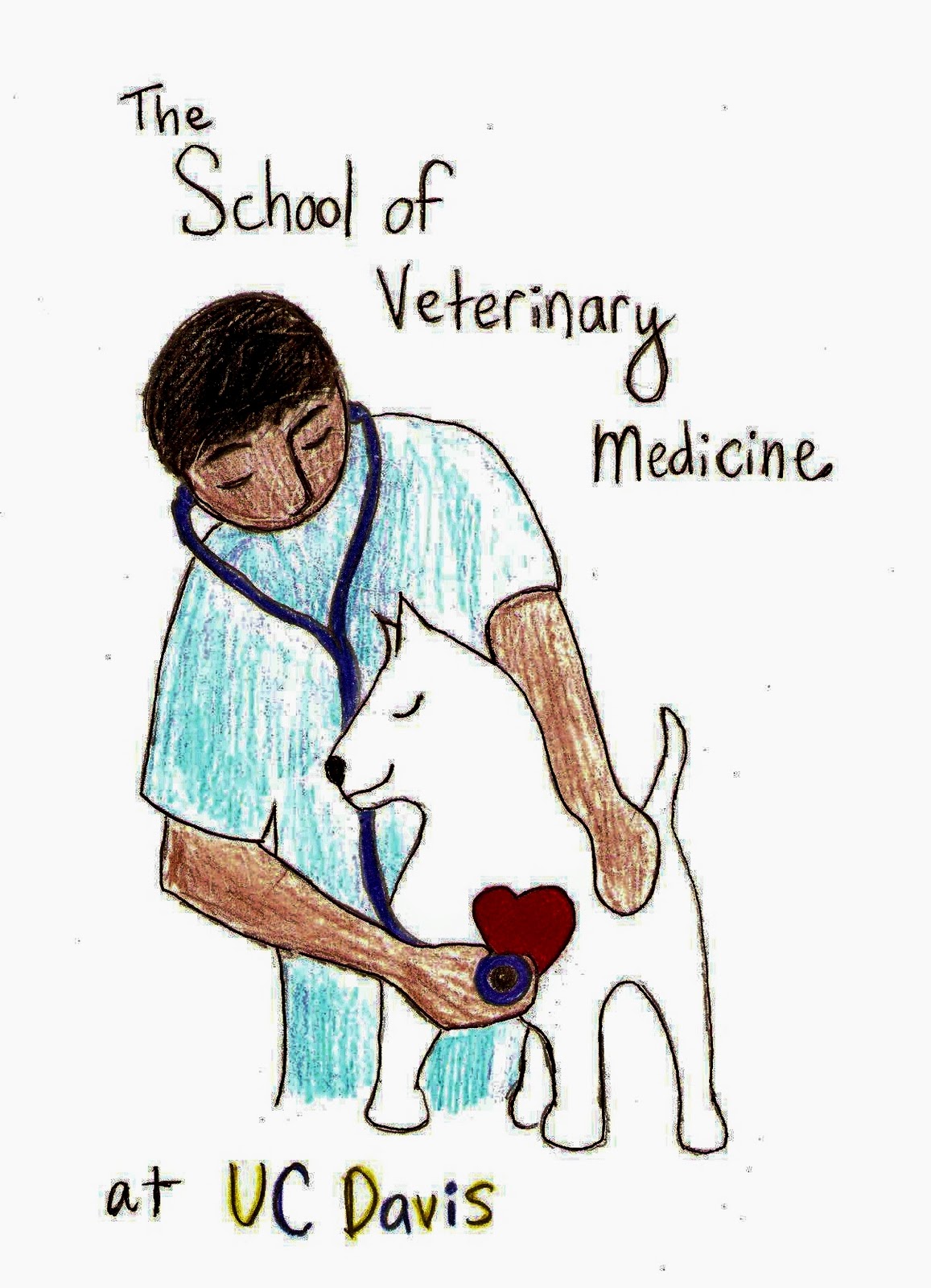
Designing our Class T-shirt

My sister is such a great artist, when given the task to design a shirt for the SVM class of 2014, this is what she comes up with. It is so cute! I love my sister so much and I hope she knows how talented she is. I also have to give credit to her boyfriend Josh who helped! Thanks Mel and Josh for such a wonderful T-Shirt Design! I hope it wins the design contest!
Love Sisterly


Monday, January 24, 2011

VBMA Lunch Talk: Building Revenue For Your New Practice


I am a member of the UC Davis Veterinary Business Management Association and today we had the pleasure of listening to a talk given by Howard Friedman, MBA on "How Graduating Veterinary Students Can Help Build Revenues for their New Practice." I attended the lunch even though I am still more than 3.5 years away from even possibly joining a practice because I was interested and there was free lunch! (One of the many benefits of veterinary school=lots of free lunches).

I became very absorbed in the talk which introduced something I don't often get to think about, "what happens after veterinary school?" As a new vet, you have to develop an entirely new client base. If you are joining an existing practice, you have to find a way to contribute to this practice while also establishing your own clients and building long-lasting relationships.

The majority of the meeting focused on marketing strategies in securing new clients and marketing yourself as a new veterinarian. Mr. Friedman mentioned how most veterinary practices get new clients via WOM (word of mouth). If word goes around that your practice is the best, animal owners will spread the word to their fellow animal owners. This makes sense and it's been in use since communication began!

Other proactive marketing strategies that were mentioned were websites and blogs. Having a GOOD website with practice information, pictures and contact information can really help your business. Direct marketing (mail and print media) were also mentioned. Providing coupons of sorts can encourage owners to come to your clinic in the first place, then they can see what a great clinic you have to offer. I think one of the biggest forms of marketing is community exposure and media relations. Getting involved in your community is a powerful marketing strategy and promotes animal health and wellness in your area.

One of my biggest ideas on improving revenues for a veterinary business is offering free client education sessions. As a pet owner, you probably don't really want to see your veterinarian very often, but it is important to take your animal to the vet at least once a year for good preventative care and your pet's health. I also believe any good pet owner would be interested in increasing their pet's wellness.

I think it is important for new veterinary graduates to discuss their ideas for increasing the practice's revenue. Besides you are fresh out of vet school and you may feel like you still have a lot to learn, but the practice you join has a lot to learn from you too!

Thursday, January 20, 2011

The Impostor Syndrome

Yesterday before my lab practical portion of my GI anatomy exam, after I had completed the lecture portion, I was talking with some of my classmates. The conversation began with preparing for the lab practical, but then shifted towards feelings about exams and how we felt about ourselves at vet students. All of us seemed to have this feeling that we just weren't good enough or wondered if we even belonged here in vet school. We all thought we were for the most parts successful undergrads, but being in a professional school is totally different. I think there is pressure that comes from the fact that you are supposed to be a professional, have the knowledge of a professional, basically we feel as though we should be getting A's on every exam for the amount of time we put into studying and stressing about them. 

As Pre-Vets, you are very competitive, essentially competing with 1,200 other people for 133 or so spots at each one of the 22 or so vet schools in the US. And let me tell you, the interview process is nerve racking if you are lucky enough to get one. I applied two times to UC Davis and didn't get an interview the first time. I didn't give up that easy, I applied the following year, landed an interview and got a spot in the class of 2014. So I really encourage those of you who have applied multiple times not to give up too easy. Meet with the admissions committee and ask them where your application was lacking and know that you have a whole year to improve it. They want you to be persistent, I think that is why a lot of people might not get in their first application.

Even after being accepted to veterinary school at UC Davis, I still have this "impostor syndrome."And I'm not the only one plagued with it. Many of my friends feel the same way about themselves. The impostor syndrome is when one feels like they don't belong, as if they were a fraud. These feelings are common for new professional students, but not easy to hide from oneself.

I think the important part to remember when dealing with these impostor feelings is that everyone has to start somewhere and the fear of beginning a new and demanding professional career is daunting. You feel awkward which puts you in a place to not be comfortable with yourself and question things you actually do know. Allowing this self-doubt to take over can create a vicious cycle of apprehension, anxiety, depression, and paralysis of your life. It's almost impossible to fight off the impostor syndrome since it is so powerful in the beginning, but it helps talking to others that feel the same way. I realized the way to overcome this syndrome is to not fight it, but try to understand it and that it is an appropriate reaction to feel. After talking to my classmates, I was shocked that many of them felt the same way I did. Then I remembered that we are all colleges and we are all in this class to help each other out. A lot of us may look like we're fine on the outside, but we hide under our feelings of "impostor syndrome" hoping that no one will notice that we somehow accidentally made it into the class of 2014. I remember during orientation, I thought that they were going to make an announcement and say, "actually you didn't make it into vet school"....and send me on my way. I think the impostor syndrome is something I and a lot of my colleges will have to deal with for life. From here on out, I don't think it gets any easier! I read these helpful hints on a really neat website: http://www.myevt.com/columns/11/impostor-phenomenon

1. What you’re feeling on the inside is not necessarily visible on the outside. Taking a deep breath and holding your head high as you walk in the exam room can make you appear more confident.

2. Concentrate on your client and your patient, not on your feelings of awkwardness or unease. By focusing on those who have come for your expertise and care, you can often distract yourself from the worst of your apprehensions.

3. Acknowledge your new status. The Impostor Phenomenon can intensify if you attempt to hide your unease. Letting your client know that you are still learning your way around can put you both at ease.

4. Accept compliments. When we feel insecure, it’s difficult to acknowledge that others may see something positive in our actions. Rather than deflecting positive remarks, simply smile and say thank you. Then repeat the compliment to yourself several times!

5. Don’t be afraid to ask for help. Acknowledging the expertise of others and asking for needed assistance encourages mutual respect.

6. Watch your negative self-talk. Imagine what it would be like to have a colleague following you, criticizing you and pointing out every small error. Your self-critical voice can have the same destructive effect, so ease up on the self- assessment.


Take A Look At These Impostors Below!!!!


Tuesday, January 18, 2011

Attention Pre-Veterinary Students and Blog Readers

Hi Everyone,

First off, thanks for reading my blog! I really enjoy it when what I write is useful and interesting to others. Second, I created this blog in part to keep a record of my life in veterinary school as well as inform my family and friends about my life so they can keep updated on what I'm doing and why I don't get to visit too often! I also created this blog to answer questions about what it is like getting into vet school and becoming a veterinarian. I want to open this blog up for any questions people may have about life in vet school, although I am quite busy, I am sure I will find time to answer you! So please feel welcome to email me with questions or leave comments on my blog.


Thanks for reading!

Kristina N.
hamaleo11@gmail.com

Monday, January 17, 2011

Meditation for Vet Students

 I've recently incorporated mediation into my life. I attended an information session by the famous Dr. Clark (quite more than the average professor/veterinarian), Dr. Clark shared his personal knowledge and practice of meditation with us. Although Dr. Clark is not an expert, I believe he gave me a great introduction to what meditation is all about and how to get started. I debated even going to the meeting due to time constraints (mainly lots of studying that needed to be done) but luckily I passed a friend in the hall on her way to the meeting.

Meditation helps defuse stress while strengthening brain function and vitality. Many of you may have a preconceived thought about what you think meditation is.  But let me tell you, meditation is exactly what you want it to be. "Meditation is essentially training our attention so that we can be more aware." -Salzberg

What is the science behind it? "Advances in brain monitoring and imaging, such as functional MRI, have made it possible to watch the brain in action during meditation...the practice of meditation seems to prime brain cells to fire together in patterns that strengthen key brain structures-those for example, important in tasks such as decision-making, memory, and emotional flexibility."-Salzberg

How does this relate to veterinary students or anyone for that matter? As a veterinary student myself, I have experienced first hand the stress a professional school puts on my life. Veterinary medicine is a difficult profession, although very rewarding, it puts you under a large amount of pressure. I feel as though meditation helps me relax and feel better about dealing with my stress in a more healthy way. There is no chanting, incense, or religion involved. I simply listen to soft, gentle, nature music (such as ocean waves radio on Pandora) and let my mind go blank. Of course, my mind strays, but I gently bring my attention back to the focus of meditation. I focus on my breathing pattern and am aware of my breath flowing through my body. I do my best to fit my meditation practices into my busy schedule. Since I started meditating, my goal has been to meditate at least 3-4 times a week for about 15-20minutes at a time. I find it comfortable to sit cross-legged on a bolster in a dark room and I close my eyes. So far I'm really enjoying it and I like the guided meditations in Sharon Salzberg's new book "Real Happiness: The Power of Meditation". I encourage anyone to try meditation, but keep in mind, it is not easy. Not that it is hard, but it is essentially training your mind. Kind of like an exercise regimen, it takes work. Don't give up in the beginning simply because it's hard to keep your attention focused or find time for the practice, really give it a good shot and if you have trouble seek help. Here are some meditation basics courtesy of Dr. Clark.

Dr. Clark's Meditation Reminders

1) Set a time frame for the session and stick to it

2) Find a comfortable position and then be still

3) Keep returning your focus to your breathing

4) Count or repeat a phrase if that is helpful

5) When your mind strays, don't reprimand-instead redirect

6) Notice, as an observer, the thoughts and feelings that arise

7) Let go and accept everything that arises

8) Now is not the time to "fix" things-instead "just be"

9) Be patient with yourself and persistant with this practice

10) View this "mental vacation" as a gift to yourself

Resources: 
Mindfulness in Plain English by Bhante Gunaratana
Real Happiness: The Power of Meditation by Sharon Salzberg
Thursday, January 13, 2011

Leo

Serving as both teacher and friend, H A Maleo, or Leo, taught me many of life's lessons. I fell in love with horses at age six, and several years later I wanted my own horse. I had already begun to work off my riding lessons at the local barns, and then finally the chance to own my own horse came along.

Leo was a rambunctious four year old gelding with little training. He had a very unique personality that I grew to love. I convinced my parents to help pay for half his cost (what I couldn't afford), and I brought Leo along in his training by taking lessons. Months later, we had our debut at a local 4-H horse show. We took a blue ribbon in showmanship and placed in the western classes we entered. Leo and I loved the show ring! We then attended several schooling shows, primarily showing western pleasure.

Not only did Leo shine in the arena, he also excelled on the trails. We took up endurance riding and rode several 25/30 mile rides after he turned five years old. Leo was a trooper, raking in ribbons one weekend and top tens another! Some weekends, we took time off from showing and endurance rides, attending local gymkhanas for fun. One hot summer day at a show, my friend's horse came up lame. I felt badly seeing her horseless at the show, so I offered her the use of Leo. I watched her win two second place ribbons in her English classes. Her success with Leo inspired me to begin riding English again. I took lessons at a local hunter/jumper barn, and soon enough I was showing All-Around!

Almost a year later, though, Leo became quite lame. He was diagnosed with OCD, a joint disease caused by improper nutrition as a youngster. Unfortunately, Leo would have OCD for life and we realized our active training and showing schedule would be too much for him to handle. I rode Leo sometimes just for fun, but we both knew things wouldn't ever be the same. Leo grew bored not having a job, and seemed saddened by the lack of competition. He missed the spotlight, the line-ups, and most importantly his special "what a great job!" bran mashes when we got home from a show. I began showing other horses while Leo stayed at home- but he was never far from my heart. I planned on keeping him, because he was my loyal partner.

By chance, someone who needed him first came along. Family friends had just lost one of their horses, and they were heart broken. They needed a good horse. The couple rode in the mounted police force, participated in California State Fair, search and rescue operations, and parades. Since they wouldn't be doing any heavy riding, it would be the perfect solution for Leo! They gave him a wonderful new home. They loved Leo from the start, and Leo grew to love them.

Last year at the state fair, I saw Leo patrolling the crowds. He joyfully nickered a greeting when I called his name. Leo is truly a superior example of a versatile Arabian horse, and stands out among his peers in a magnificent breed! Thank you, Leo!

Now that I'm in vet school and I look back on this essay I wrote to nominate Leo for the Arabian Horse Association's Arabian Horse of the month, I just can't get over how sad it was to let Leo go. He is surely happy where he is, but I can't help but miss him. It is interesting to be in my radiology classes and hear the term "OCD". Osteocondrosis Dessicans. It has so much more weight to it since I have been through it with Leo. I hope to do research someday to figure out how to prevent this disease from happening. If you want to learn more about OCD, please visit this website: http://www.merckvetmanual.com/mvm/index.jsp?cfile=htm/bc/90404.htm

Saturday, January 8, 2011

MERCER Veterinary Clinic For the Homeless

Every second Saturday at Loaves and Fishes in Sacramento, there is a veterinary clinic put on by the UC Davis veterinary students that offers care to pets belonging to the homeless. The clinic is funded by grants, donations and fundraisers. Its policy requires that its patients be spayed or neutered, and clients be confirmed as homeless by Loaves and Fishes. The MERCER clinic has been successful for the past 15 years and provided valuable services to the homeless of Sacramento. Many of you may wonder why homeless people have pets? How could they possibly own a cat? Well I think Dr. Gershwin says it best, "you have to realize for these people that have very little, that (an) animal is something solid and stable in their life, It provides companionship, love, and it's a very important part of their life. I've seen our clients go out and save another animal another homeless person has been mistreating." Sometimes these pets are their life. The majority of the pets are well cared for and come to the clinic monthly for routine heartworm and flea preventative. 
 Today I volunteered at the MERCER clinic alongside several of my classmates and upperclassmen. My Dad also came along to help out and see what MERCER was all about. He was very helpful and seemed to enjoy working the clinic. Today it was about 35-40 degrees F and it was freezing in the warehouse where MERCER is held. We didn't see as many patients as we usually see probably because of the cold, however there were at least 50 patients today. On an average day at MERCER, we can treat up to 180 pets. Today I got to give vaccines, draw blood for pre-surgery blood work and work with some really cool people. It was a great experience!
I have volunteered at MERCER for the previous two years. I started volunteering through the vet aides club as an undergraduate when I was taking my pre-veterinary courses at UC Davis. It was a great opportunity for me to work with animals alongside veterinary students and I was able to get a lot of hands-on experience with animals! As a vet aid member your job is to assist the veterinary student in any way possible which may include restraining animals, drawing up vaccines, flea medication, running to the lab, and recording information. 

Now that I'm a first year veterinary student, the roles have turned. Now I'm the Doctor! At MERCER, the veterinary students see and treat the patients. However we are not alone, we have several dedicated Veterinarians that volunteer every month to assist us. If we need their help, we just add our name to the list. It's a wonderful learning opportunity for us and it really helps people and pets that need it! 


I would like to dedicate this blog post to Anneke Vos, who worked three decades on behalf of the pets of Sacramento's homeless population and sadly died last Monday of undetermined causes at the age of 86. She will be greatly missed and was such a wonderful woman! http://www.sacbee.com/2011/01/06/3302968/obituary-to-the-end-anneke-vos.html


More LINKs: